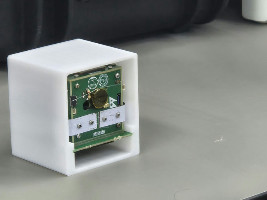
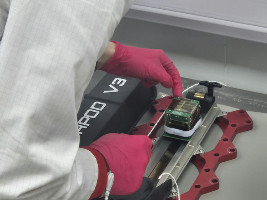
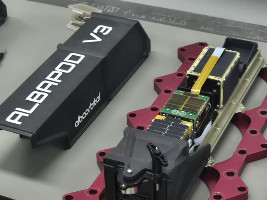
SanoSat-3 Spacecraft

SanoSat-3
SanoSat-3
SanoSat-3
Spacecraft UTNH-SAJILO-SAT (Sanosat-3)
Spacecraft type PocketQube
Units or mass PocketQube 1p
Status not launched, expected in 2026
Launcher Falcon 9, (Transporter-18)
Entity name ORION Space
Institution Company
Entity Academic / Education
Headquarters Nepal
Oneliner

SanoSat-3 has the same mission as SanoSat-2, but with a magnetorquer instead of a permanent magnet for ADCS (detumbling).

Description

The missions of SanoSat-3 are:

  1. Digipeater: It is an Amateur Mission. HAM Radio users can transmit a short message to the satellite, and the satellite repeats the message to all HAM Radio users. This mission has been successfully tested on SanoSat-1.
  2. Camera Mission: Take photos using a 5MP Camera, and send the images as SSDV packets via GFSK modulation so the amateur community can downlink and decode them.
  3. Morse Code: The satellite also sends a Morse Code identification. This helps amateur radio operators to: 1) detect the presence of the satellite, and 2) measure basic properties of the signals: strength, fading (spin), Doppler shift (speed), etc.
  4. ADCS Mission: The project has an active ADCS feature gained through the B-dot algorithm. The algorithm utilizes data from sensors like: imu and magnetometer
  5. Deployable Panels Testing: This project also demonstrates deployable solar panels using a custom-designed hinge system.

The satellite's primary mission is to serve as a Digital Repeater (Digipeater). Amateur Radio operators will be able to upload a message to the satellite, and it will transmit it back for all HAM users to receive. The secondary mission is to take images from space for educational use. The payload consists of a 5 MP camera and a microcontroller that sends the image to the OBC, which then transmits it to the ground station via SSDV using GFSK packets. Additionally, the satellite consists of an IMU and Sun sensors, whose data are transmitted to the ground station via GFSK packets. Next, the satellite also consists of an active ADCS mission planned to be retained through PCB coils (magnetorquers) to test the B-dot algorithm for the detumbling of the satellite. Therefore, amateur radio operators will be encouraged to receive, decode, and archive telemetry and image transmissions using standard amateur radio ground stations. 

Sources [1]
Photo sources [1] [2]

Last modified: 2026-08-01

Feel free to connect at any time.

Created by Erik Kulu

Email: erik.kulu@nanosats.eu
LinkedIn: linkedin.com/in/erikkulu

Social Platforms

LinkedIn: Nanosats
Twitter: @nanosatellites

Sister Websites

NewSpace Index: newspace.im
Factories in Space: factoriesinspace.com

Copyright © 2014 - 2026 Erik Kulu