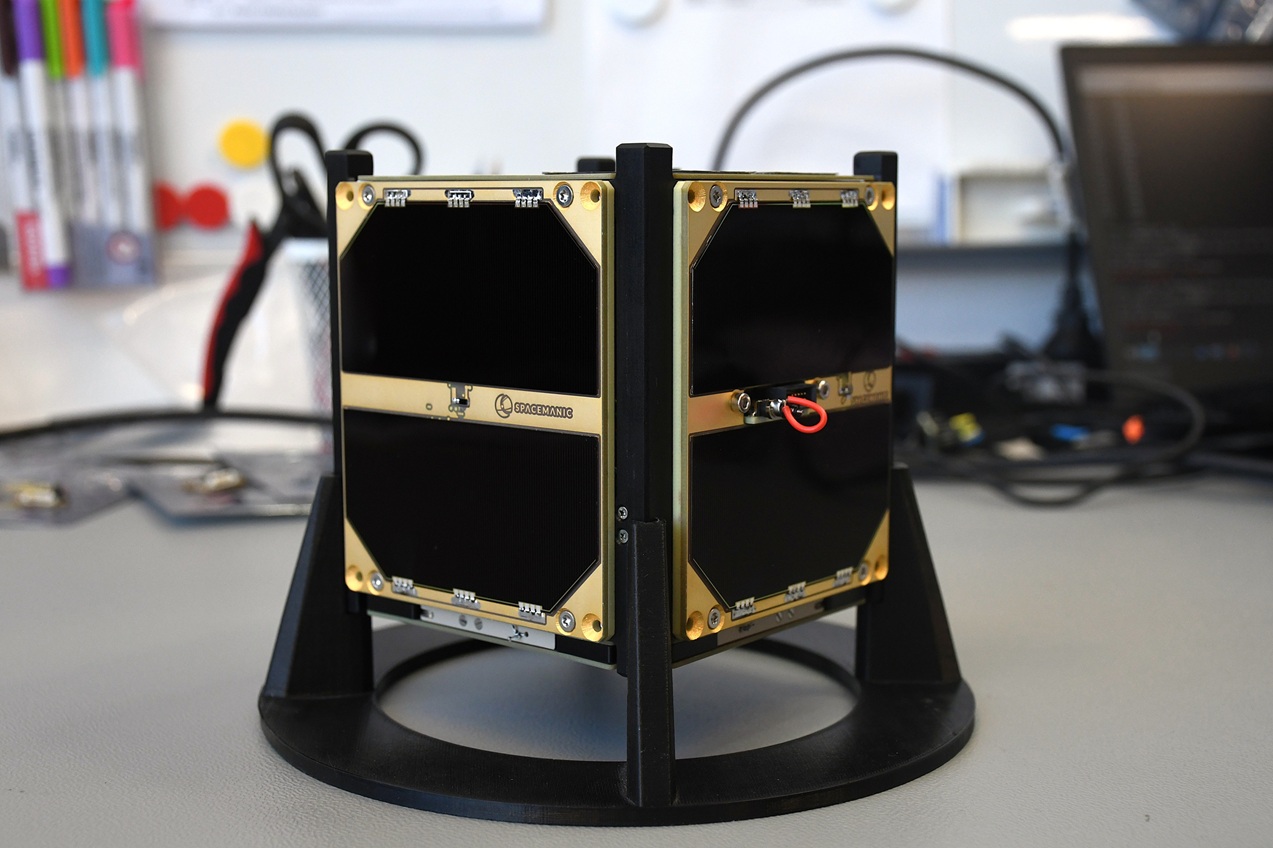
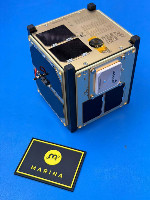
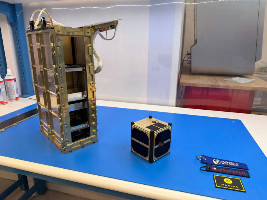
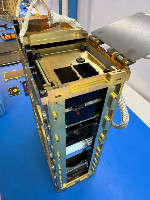
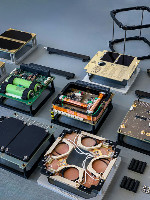
MARINA Spacecraft

Spacecraft name MARINA
Spacecraft type CubeSat
Units or mass 1U
Status not launched, expected in 2026
Launcher Falcon 9, (Transporter-17)
Organization Technical University of Kosice
Institution University
Entity Academic / Education
Nation (HQ) Slovakia
Nation (AIT) ?
Manufacturer AIVT by ?
Operator ?
Oneliner

Support the global amateur radio community with various HAM services and activities.

Description

MARINA is a 1U CubeSat mission to support the global amateur radio community with various HAM services and activities. The MARINA nanosatellite will serve exclusively to support the global amateur radio community.

The nanosatellite is designed as an experimental and communication platform that will provide amateur radio operators around the world with the opportunity to communicate with each other via a digital transponder, while also enabling the reception of images of Earth distributed in SSDV mode. The mission is designed with an emphasis on accessibility for the widest possible amateur radio community.

The satellite will operate in low orbit with a planned lifetime of 5 years. The primary goal is to provide a practical platform for connections between amateur radio operators and the reception of images of Earth, which were taken by an on-board camera, using SSDV. The project represents a significant opportunity for the amateur radio community, not only in terms of communication possibilities, but also education. Low requirements for ground equipment will allow the involvement of students, novice radio amateurs, and experienced operators. The satellite will serve as an experimental platform for testing new digital protocols and communication techniques in a real space environment.

We plan to actively collaborate with radio clubs and educational institutions to promote interest in satellite communications and space technologies. The nanosatellite will operate in three basic modes. Approximately 40 percent of the time will be reserved for an active transponder, during which amateur radio operators will be able to make connections with each other. Another 40 percent of the time will be devoted to broadcasting SSDV images. The remaining 20 percent of the time will be reserved for telemetry transmission and reception of commands from control stations. The mission will be controlled from two ground stations, primary and backup, which will ensure regular communication with the satellite, monitoring of system status, and coordination of activities. The main service of the nanosatellite MARINA will be a digital transponder enabling communication between radio amateurs. 

Sources [1] [2]

Last modified: 2026-01-04

Feel free to connect at any time.

Created by Erik Kulu

Email: erik.kulu@nanosats.eu
LinkedIn: linkedin.com/in/erikkulu

Social Platforms

LinkedIn: Nanosats
Twitter: @nanosatellites

Sister Websites

NewSpace Index: newspace.im
Factories in Space: factoriesinspace.com

Copyright © 2014 - 2026 Erik Kulu
