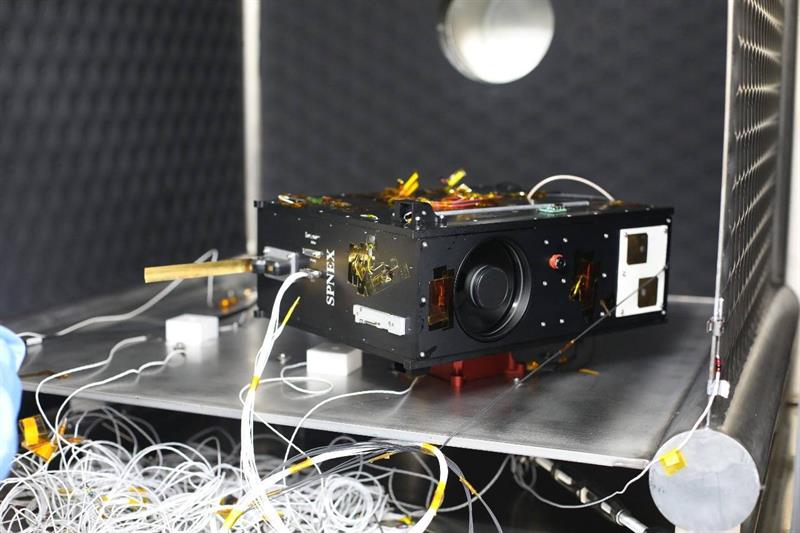
| Satellite name | SPNeX (Space Plasma Nanosatellite Experiment) |
|---|---|
| Spacecraft type | CubeSat |
| Units or mass | 6U |
| Status | Operational (News from 2025-12-14) |
| Launched | 2025-12-10 |
| NORAD ID | ? |
| Deployer | ? |
| Launcher | Lijian-1 |
| Entity name | Egyptian Space Agency (EgSA) |
| Institution | Space agency |
| Entity | Government (Civil / Military) |
| Nation | Egypt |
| Oneliner |
Study plasma characteristics in the ionosphere. |
| Description |
The Space Plasma Nanosatellite Experiment (SPNeX) is a CubeSat mission, sponsored by the Academy of Scientific Research and Technology (ASRT) and manufactured by the Egyptian Space Agency (EgSA). The project has three primary objectives: firstly, to enhance knowledge in the fields of aeronomy and space weather; secondly, to demonstrate novel engineering technology; and thirdly, to advance higher education. The scientific focus of SPNeX is the study of the temporal and spatial variability of ion-neutral interactions in the equatorial Ionosphere-Thermosphere (I-T) region, specifically over Africa. The mission consists of a 6U CubeSat that will take in-situ measurements of the ionospheric plasma composition and neutral composition on timescales of less than an orbital period. This data will be used to investigate the effects of space weather on the ionosphere, thermosphere, and mesosphere (I-T-M) system. In addition to being the first African spacecraft to take in-situ ionospheric measurements over Africa around the (I-T) region, SPNeX aims to advance the state-of-the-art in spacecraft formation flying, with a particular focus on a novel double Langmuir Probe sensor. CubeSat development will be used as a vehicle for education, with students ranging from M.Sc. to Ph.D. candidates involved in the project. The program's distributed nature and varied levels of CubeSat experience among collaborating departments present significant educational opportunities, as well as challenges such as cross-departmental communication and coordination, document sharing and file management, and hardware development. Nonetheless, due to the good spatial coverage of SPNeX measurements, the mission has important implications for the more realistic modeling of ionospheric irregularities both in their global extent and in their intensities, making it a significant contribution to the field of space research. |
| Sources | [1] [2] [3] |
| Photo sources | [1] |
| On the same launch |
Last modified: 2025-12-23
