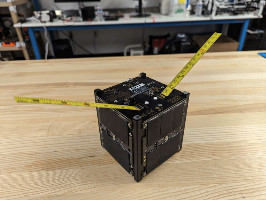
| Name | Proves - Alcyone (Pleiades Five) |
|---|---|
| Form factor | CubeSat |
| Units or mass | 1U |
| Status | No signal? (Confirmations not found as of 2026-07-29) |
| Launched | 2026-04-11 |
| NORAD ID | ? |
| Deployer | NRCSD (NanoRacks CubeSat Deployer) [Quad-M] |
| Launcher | Falcon 9 (Cygnus) (NG-24) |
| Entity name | Columbia University |
| Institution | University |
| Entity type | Academic / Education |
| Headquarters | US |
| Manufacturer | AIVT by Cal Poly Pomona (Bronco Space) |
| Partners | Cal Poly Pomona (Bronco Space) |
| Oneliner |
One of five satellites in the joint The PROVES Project CubeSat educational mission. |
| Description |
One of five satellites in the joint The PROVES Project CubeSat mission. The Pleiades Rapid Orbital Verification Experiment System PROVES Project is an extension of the Pleiades CubeSat Cluster, an inter university initiative aimed at testing open-source CubeSat architectures, promoting low cost CubeSats for educational access to space, and creating infrastructure that enhances access and interest in the radio art through satellite communications. It is a 1U CubeSat with the following functions.
All of the satellites participating in The PROVES Project mission will offer digital packet relay services to the amateur radio community as a primary mission. Whenever possible, radio amateurs will also be invited to attempt to route packets between the satellites using our open source DRIFT (Dynamic Relay for Intersatellite Fault Tolerance) protocol, published on our website. We will also publish the open source design of the PROVES Ground Station Kit. This design describes the essential hardware and software required for an amateur operator to construct a ground station capable of downlink and uplink to the PROVES satellites via UHF. PROVES - Atlas will attempt to engage and educate students and radio amateurs around the world with an understanding of the impact of space mission geometry on radio communications through its onboard attitude determination system. By making attitude information available to amateurs contacting the satellite, the radio operators can experiment with optimal orientations and timings for ideal link performance. |
| Notes | |
| Sources | [1] [2] |
| Photo sources | [1] |
| COTS subsystems |
|
| Keywords | Open-source |
| On the same launch |
Last modified: 2026-07-29
